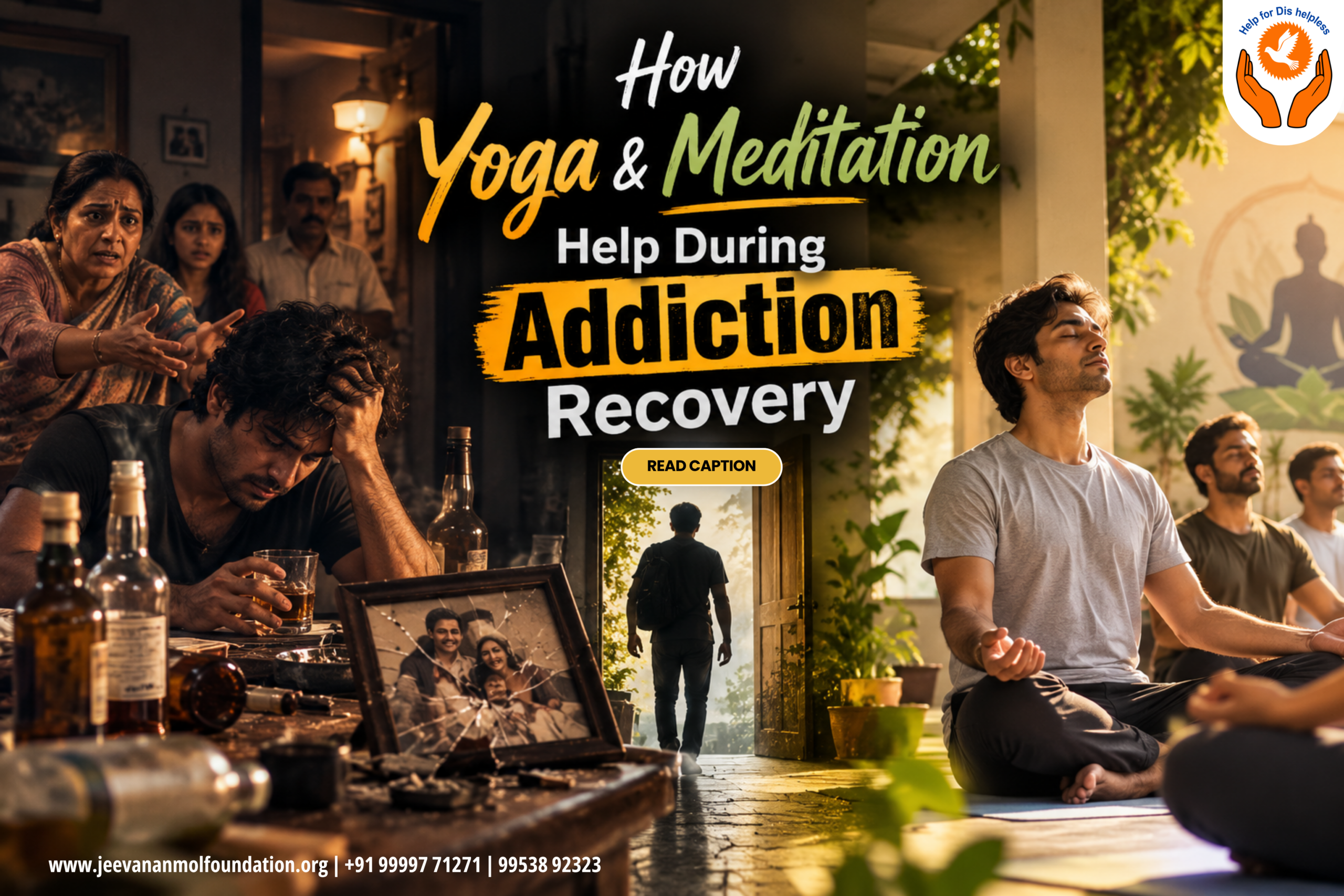
How Yoga & Meditation Help During Addiction Recovery
Addiction recovery is not only about stopping alcohol or drug use. It is also about learning how to manage stress, emotions, cravings, negative thoughts, relationships, and daily routines without depending on substances.
This is where yoga and meditation can become valuable complementary practices during recovery.
Yoga works through physical movement, breathing, balance, and relaxation, while meditation helps develop awareness and emotional regulation. When included as part of a structured recovery programme, these practices may help individuals develop healthier ways of dealing with stress and difficult emotions.
However, it is important to understand one thing clearly: yoga and meditation are supportive tools, not replacements for professional addiction treatment, medical care, counselling, or prescribed medication.
Let’s understand how they can contribute to the recovery journey.
Understanding Addiction Recovery
Addiction can affect much more than physical health. It can influence the brain, emotions, behaviour, relationships, work, and decision-making.
During recovery, a person may have to deal with:
- Cravings
- Stress and anxiety
- Irritability
- Sleep difficulties
- Negative thoughts
- Emotional triggers
- Lack of motivation
- Difficulty concentrating
- Fear of relapse
- Changes in relationships
Simply removing the substance from someone’s life doesn’t automatically teach them how to handle these challenges.
Long-term recovery requires developing healthier coping mechanisms.
Yoga and meditation can be part of that process.
What Is Yoga-Based Support in Addiction Recovery?
Yoga combines physical postures, controlled breathing, relaxation, and mindful awareness.
In a rehabilitation setting, yoga can be adapted according to an individual’s physical condition and recovery stage.
A typical session may include:
- Gentle stretching
- Yoga postures
- Breathing exercises
- Relaxation techniques
- Mindfulness
- Short meditation
The objective isn’t to become physically flexible or perform difficult poses.
The focus is on developing awareness, discipline, relaxation, and a healthier connection between the body and mind.
1. Yoga Can Help Manage Stress
Stress is an important issue during addiction recovery.
A person may previously have used alcohol or drugs as a way of escaping stressful situations. During recovery, they need alternative ways to respond to stress.
Yoga encourages slow, controlled movements and breathing, which can promote relaxation.
Regular practice may help individuals develop a healthier response to everyday stress.
Instead of immediately looking for a substance when feeling overwhelmed, a person can gradually learn to pause, breathe, and regulate their response.
2. Meditation Helps Develop Awareness
Addiction can involve automatic patterns of behaviour.
A person may experience a trigger, craving, thought, or emotional reaction and immediately act on it.
Meditation encourages people to observe their thoughts and feelings without automatically reacting to them.
For example:
Trigger → craving → automatic reaction
can gradually become:
Trigger → awareness → pause → healthier response
This small pause can be extremely valuable during recovery.
Meditation does not make cravings disappear instantly. Instead, regular mindfulness practice can help individuals become more aware of their thoughts, emotions, and physical sensations.
3. Yoga Can Encourage a Healthier Routine
Addiction can disrupt daily routines.
Sleep schedules may become irregular, meals may be neglected, physical activity may decrease, and responsibilities may be ignored.
Recovery requires rebuilding structure.
Including yoga at a fixed time each day can create a simple, healthy routine.
For example:
Morning → Yoga → Healthy breakfast → Counselling → Work/activities → Relaxation → Sleep
A structured routine can help replace unproductive habits with positive activities.
4. Meditation Can Help With Emotional Regulation
People recovering from addiction may experience difficult emotions.
These can include:
- Anger
- Frustration
- Fear
- Loneliness
- Guilt
- Shame
- Anxiety
If someone has historically used substances to escape uncomfortable emotions, learning to experience those emotions without immediately reacting to them becomes an important recovery skill.
Meditation encourages individuals to notice emotions rather than automatically acting on them.
With guidance and regular practice, mindfulness can become one tool for developing greater emotional awareness.
5. Yoga Encourages Physical Activity
Physical activity is an important part of a healthy lifestyle.
Yoga provides gentle movement and can help people reconnect with their bodies after periods of substance misuse and neglect.
Depending on the person’s health and physical ability, yoga may support:
- Flexibility
- Mobility
- Balance
- Body awareness
- Relaxation
- General physical activity
It is important that exercises are adapted to the individual’s physical condition. People with medical conditions or physical limitations should seek appropriate professional guidance before starting an exercise programme.
6. Meditation May Help People Recognize Triggers
Relapse prevention involves understanding what situations, emotions, people, or environments can increase the risk of returning to substance use.
Triggers may include:
- Stress
- Arguments
- Certain friends
- Specific locations
- Loneliness
- Financial problems
- Emotional pain
- Celebrations or social situations
- Memories associated with substance use
Meditation encourages self-observation.
Over time, a person may become better at noticing:
“I’m feeling stressed.”
before it turns into:
“I need something to make me feel better.”
That awareness can provide an opportunity to use healthier coping strategies.
7. Yoga Can Support Better Sleep Habits
Sleep problems are common during addiction recovery.
Irregular sleep can affect:
- Mood
- Concentration
- Energy
- Stress tolerance
- Motivation
Certain gentle yoga and relaxation practices may help prepare the body and mind for rest.
A consistent evening routine involving gentle stretching, breathing exercises, and relaxation may be useful for some individuals.
However, persistent or severe sleep problems should be discussed with a healthcare professional rather than treated solely through yoga or meditation.
8. Meditation Can Help Break the Cycle of Automatic Thinking
Addiction can sometimes be accompanied by repetitive thoughts such as:
- “I need this to relax.”
- “I can’t handle stress without it.”
- “Just one time won’t matter.”
- “I have already failed, so there is no point trying.”
Meditation doesn’t require a person to fight every thought.
Instead, the individual can learn to recognize the thought and let it pass without immediately acting on it.
This can gradually create greater distance between a thought and a behaviour.
9. Yoga and Meditation Can Build Self-Discipline
Recovery requires consistency.
Attending counselling, following treatment recommendations, maintaining healthy routines, avoiding triggers, and building supportive relationships all require effort.
Yoga and meditation can introduce small daily commitments.
For example:
10–15 minutes of meditation every morning
or
20–30 minutes of guided yoga several times a week
can create a sense of routine and personal responsibility.
The goal isn’t perfection.
The goal is consistency.
10. They Can Encourage a Positive Lifestyle
Recovery becomes stronger when substance use is gradually replaced with healthier activities.
A person may begin exploring:
- Yoga
- Meditation
- Exercise
- Walking
- Reading
- Music
- Sports
- Healthy nutrition
- Meaningful social activities
- Hobbies
These activities can help create a lifestyle in which alcohol or drugs no longer occupy the central role.
Yoga, Meditation and Cravings
One of the biggest questions families ask is:
Can yoga and meditation stop drug or alcohol cravings?
The answer isn’t that simple.
Cravings are complex experiences influenced by biological, psychological, and environmental factors.
Yoga and meditation should not be presented as a guaranteed way to eliminate cravings.
Instead, they can be used as complementary tools to help an individual:
- Notice cravings
- Manage stress
- Pause before reacting
- Practice relaxation
- Develop healthier coping mechanisms
- Become more aware of triggers
For severe cravings, medical and psychological support may be necessary.
The Role of Breathing Exercises
Breathing exercises are often included in yoga and meditation practices.
Slow, controlled breathing can help bring attention away from racing thoughts and toward the present moment.
A simple guided practice may involve:
- Sitting comfortably.
- Relaxing the shoulders.
- Paying attention to the natural breath.
- Taking slow, comfortable breaths.
- Noticing the movement of the chest or abdomen.
- Returning attention to the breath whenever the mind wanders.
There is no need to force the breath or hold it for long periods.
For individuals with respiratory or other medical conditions, appropriate professional guidance should be considered.
How Yoga and Meditation Can Fit Into a Rehabilitation Programme
Yoga and meditation work best when they are integrated into a broader treatment plan.
A structured rehabilitation programme may include:
Medical Assessment
Understanding the individual’s physical and psychological condition.
Detoxification
When medically appropriate, withdrawal and detoxification should be managed safely under professional supervision.
Individual Counselling
Helping individuals understand addiction, triggers, emotions, and behavioural patterns.
Group Support
Creating an environment where individuals can share experiences and develop social support.
Family Counselling
Helping families understand addiction and improve communication.
Yoga and Meditation
Supporting relaxation, mindfulness, physical activity, and healthy routines.
Relapse Prevention
Developing strategies for dealing with cravings, triggers, stress, and high-risk situations.
This combination is much more meaningful than treating yoga as a standalone addiction treatment.
How Families Can Encourage Yoga and Meditation
Family members can support healthy habits without forcing them.
Instead of saying:
“You have to meditate every day.”
try:
“Would you like to try a short meditation together?”
Small steps are often easier to maintain.
Families can also encourage:
- Morning walks
- Yoga sessions
- Healthy meals
- Regular sleep
- Reduced exposure to triggers
- Positive social activities
- Continued counselling
The objective is to create a supportive environment rather than another source of pressure.
What Yoga and Meditation Cannot Do
It is equally important to understand their limitations.
Yoga and meditation should not be presented as substitutes for:
- Medical treatment
- Addiction counselling
- Psychiatric care when required
- Medications prescribed by a doctor
- Medically supervised detoxification
- Emergency treatment
Someone experiencing severe withdrawal, overdose, confusion, seizures, breathing difficulties, unconsciousness, or other medical emergencies needs immediate medical attention.
Do not attempt to manage a potentially dangerous withdrawal situation with yoga or meditation alone.
How Long Should Someone Practice?
There is no universal duration that works for everyone.
Someone new to meditation may begin with 5–10 minutes of guided practice and gradually increase the duration if comfortable.
Similarly, yoga can begin with gentle sessions appropriate to the person’s health and physical condition.
The important factor is consistency rather than doing an extremely long session once in a while.
A manageable routine that someone follows regularly is more useful than an intense routine they quickly abandon.
Creating a Simple Daily Recovery Routine
A person in recovery could work with their treatment team to create a routine such as:
Morning
- Wake up at a consistent time
- Hydration
- Gentle yoga
- Short meditation
- Healthy breakfast
Afternoon
- Counselling or rehabilitation activities
- Healthy meals
- Work, education, or structured activities
Evening
- Walking or light exercise
- Family interaction
- Relaxation practice
- Reflection or journaling
Night
- Reduce unnecessary screen time
- Gentle breathing or meditation
- Consistent bedtime
The exact routine should be personalized according to the individual’s treatment plan and health needs.
Yoga, Meditation and Long-Term Recovery
Recovery doesn’t end when rehabilitation is completed.
Long-term recovery involves building a life where healthy habits become part of everyday life.
Yoga and meditation may continue to provide useful structure after rehabilitation.
For some people, these practices can become regular parts of their lifestyle rather than temporary activities during treatment.
Combined with ongoing counselling, supportive relationships, healthy routines, and relapse-prevention strategies, they can contribute to a more sustainable recovery journey.
Final Thoughts
Addiction recovery requires more than simply stopping substance use. It involves learning new ways to manage stress, emotions, cravings, relationships, and everyday challenges.
Yoga and meditation can be valuable complementary practices in this process.
Yoga encourages physical movement, breathing, relaxation, and body awareness. Meditation encourages mindfulness and greater awareness of thoughts and emotions.
But they are not magic solutions and should not replace professional addiction treatment.
The strongest recovery approach is one that combines appropriate medical care, counselling, family support, healthy lifestyle habits, and evidence-informed complementary practices.
For someone struggling with addiction, even a small healthy habit can become part of a much larger transformation.
Recovery is not about becoming a completely different person overnight. It is about building healthier choices, one day at a time.
Frequently Asked Questions
1. Can yoga cure drug addiction?
No. Yoga should not be considered a cure for drug addiction. It can be used as a complementary practice alongside appropriate medical treatment, counselling, rehabilitation, and relapse-prevention support.
2. Is meditation useful during addiction recovery?
Meditation may help individuals develop greater awareness of thoughts, emotions, stress, and cravings. It can be a useful complementary practice as part of a structured recovery programme.
3. Can yoga reduce addiction cravings?
Yoga cannot guarantee that cravings will disappear. However, relaxation, mindfulness, physical activity, and stress management may help some individuals manage triggers and respond to cravings more constructively.
4. How often should someone meditate during recovery?
There is no single schedule suitable for everyone. Beginners can start with a short, comfortable session and gradually develop a consistent routine under appropriate guidance.
5. Should yoga replace counselling?
No. Yoga and meditation should complement—not replace—professional addiction counselling or medical treatment.
6. Can family members practice yoga and meditation with someone in recovery?
Yes, when appropriate. Practising together can make healthy habits easier to maintain and can provide positive family time. The practice should remain supportive rather than becoming another source of pressure.
7. Is yoga safe during addiction withdrawal?
It depends on the individual’s medical condition and the substance involved. Some withdrawal syndromes can be medically dangerous. Anyone experiencing withdrawal should receive appropriate professional assessment and should not rely on yoga or meditation as a substitute for medical supervision.

Recent Posts
All Categories
Get the Support You Need
Professional guidance, counselling & compassionate support for a healthier, addiction-free life.